
Unpaid Claims Need a Next Step: A Weekly A/R Follow-Up Checklist
An aging report can show your billing team where balances are accumulating. It takes a closer review to understand what needs to happen next.
Two claims in the same aging bucket may need very different work. One may never have reached the payer. Another may have been denied, while a third is still processing. Sending every balance through the same follow-up routine can leave the actual problem unresolved.
Use the checklist below to turn an A/R review into a manageable action list. This is a suggested practice workflow. Apply the current requirements for each payer, plan and claim.
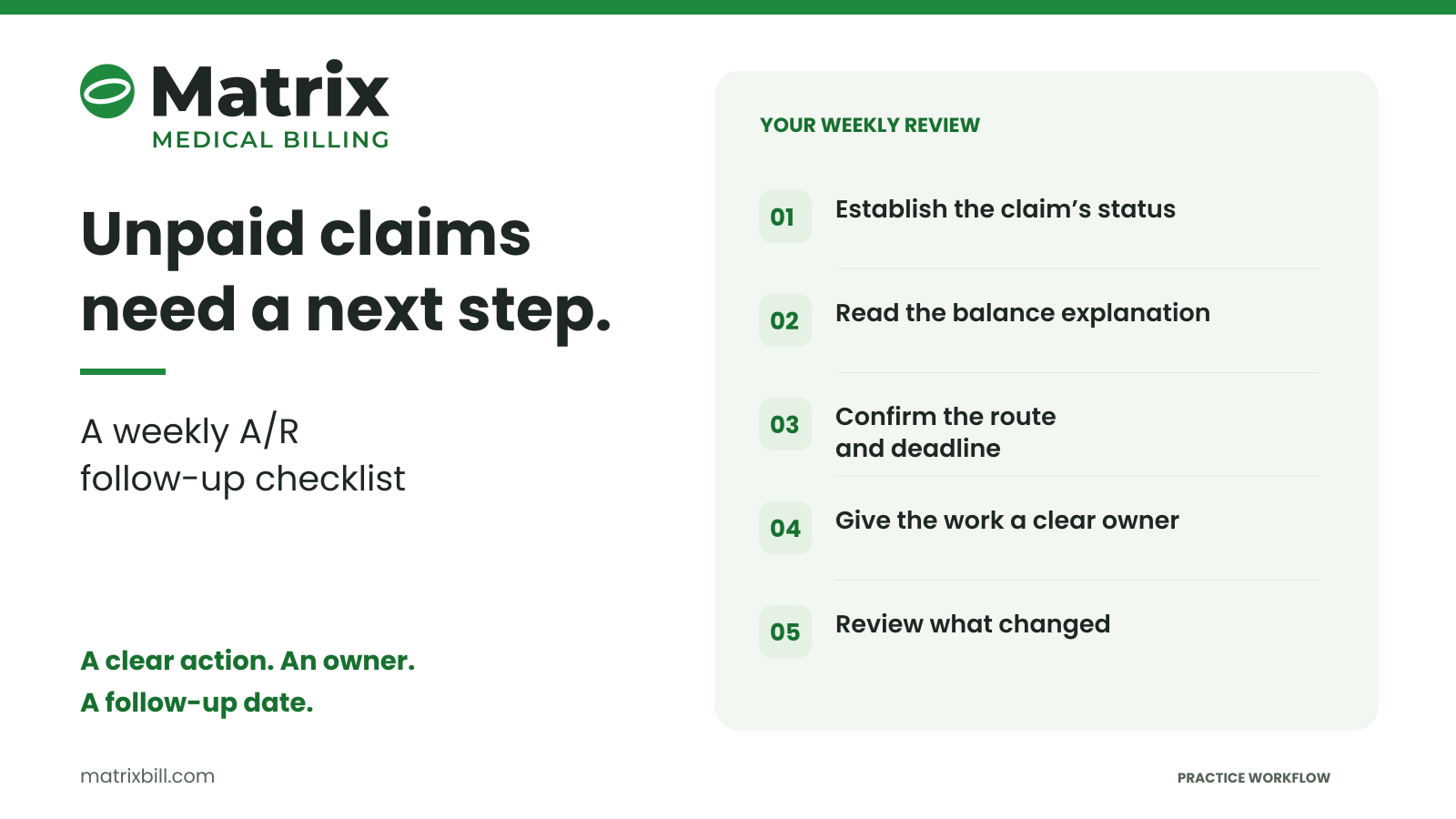
1. Establish the claim's current status
Start inside your approved billing system. Confirm that recent payments and adjustments have been posted so your list reflects the work still outstanding.
Consider grouping the items into five working queues:
Claims that have not been submitted
Rejected or returned claims needing review
Denied claims requiring a response decision
Claims accepted and still processing
Balances with verified patient responsibility
These are practical work queues, not a universal payer classification. Keep an “investigate” category when the status is unclear.
Check the submission acknowledgment and current payer status. CMS distinguishes front-end rejections from accepted Original Medicare claims and warns against resubmitting during the initial editing process because it can create a duplicate.[1] Follow the relevant payer's instructions before sending another claim.
2. Read the explanation behind the balance
An unpaid amount alone does not tell you who owes it or what action is appropriate.
Review the remittance advice or electronic remittance advice (ERA). CMS explains that claim adjustment group codes identify financial responsibility, while claim adjustment reason codes and remittance advice remark codes explain adjustments.[2]
Record the specific issue in your worklist. “Review the payer's request for missing information” gives the next person a clearer starting point than “claim unpaid.”
Before moving a balance to patient follow-up, verify responsibility and applicable billing restrictions. Do not treat every denial or unpaid amount as a patient bill.
3. Confirm the response route and deadline
A correction, reconsideration, reopening and appeal are different processes. Check which route applies before preparing the response.
For example, CMS says that Original Medicare claim corrections involving minor errors and omissions do not go through the appeals process.[3] Aetna also identifies different dispute options and explains that time limits and requirements can vary.[4]
For each item, record the applicable deadline, what starts that deadline and the source of the rule. Use the payer's current instructions and the actual notice. Do not substitute a generic “30-day” or “90-day” rule for that check.
4. Give the work a clear owner
Make the next step specific enough that another team member can understand it. A useful entry includes:
Current status and the date it was checked
The issue that needs resolution
The next action and the person responsible
The applicable filing or response deadline
A follow-up date and the evidence still needed
For example, a fictional work item might read: “Billing lead to review the returned-claim explanation, confirm the required correction and retain the submission acknowledgment.” Add the actual payer deadline after verification.
Keep claim-level details in the practice's approved systems. A general team discussion or public inquiry does not need patient names, dates of birth, medical record numbers or screenshots of patient accounts.
5. Review what changed
Use a short weekly review to identify items with no owner, missed follow-up dates and deadlines approaching. Time-sensitive work may need attention sooner than the weekly meeting.
Ask three questions:
Did the last action resolve the issue or produce new information?
What is the next step, and who will take it?
Does the same issue keep appearing elsewhere?
If several claims share a problem, assign a separate process improvement: clarify the handoff, update the internal reference or arrange focused training. Track that work alongside the individual claims so the team can see whether the change helps.
A completed phone call or submitted response is an activity. Keep the item visible until its outcome and any remaining work are recorded.
Start with one manageable group
Choose one payer or one unresolved category for your next review. Work through the status, explanation, deadline and owner. The aim is a clear action list your team can maintain, not a promise that every balance will be collected.
Matrix Medical Billing supports independent practices with payment posting, denial follow-up, appeals under payer guidelines and follow-up on aged patient balances.[5]
Request a Free A/R & Denial Snapshot: https://snapshot.matrixbill.com/
No obligation. Please do not submit patient names, dates of birth, medical record numbers, claim details or other protected health information.
Reviewed October 19, 2026. General operational education. Payer requirements can change; verify the current instructions for the specific plan, claim and response type. Following a workflow does not guarantee coverage or payment.
BLOG SOURCES
[1] CMS, Checking Medicare Claim Status, MLN3171902, March 2026, pages 2–4. Medicare-specific processing guidance. Checked October 19, 2026.
https://www.cms.gov/files/document/mln3171902-checking-medicare-claim-status.pdf
[2] CMS, Health Care Payment and Remittance Advice. Page last modified September 10, 2024. Checked October 19, 2026.
https://www.cms.gov/medicare/coding-billing/electronic-billing/health-care-payment-remittance-advice
[3] CMS, First Level of Appeal: Redetermination by a Medicare Contractor. Page last modified March 10, 2026. Checked October 19, 2026. The article uses the distinction between corrections and appeals; it does not apply Medicare's redetermination deadline to other payers.
https://www.cms.gov/medicare/appeals-grievances/fee-for-service/first-level-appeal-redetermination-medicare-contractor
[4] Aetna, Disputes and Appeals. No publication date shown. Checked October 19, 2026. Payer example supporting request-specific requirements, rather than a universal deadline.
https://www.aetna.com/health-care-professionals/disputes-appeals.html
[5] Matrix Medical Billing, Medical Billing Services for Independent Practices. Public service description retrieved October 19, 2026; retrieved page was labeled crawled the previous day.
https://www.matrixbill.com/medical-billing
